
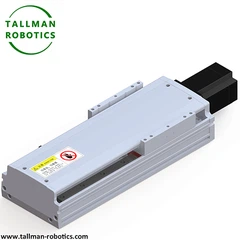


What is Belt Driven Actuator?
A belt driven actuator is a linear motion device that converts rotary motor torque into straight-line force and displacement through a closed-loop belt connecting drive and idler pulleys, prioritizing speed and extended travel over the fine positioning precision of screw-driven alternatives. As a broad product category, it spans compact enclosed slides to larger open-frame industrial units, unified by the shared operating principle of a motor-driven pulley pulling a belt-mounted carriage or load along its length.
Structure
Core components include a drive pulley coupled to the motor shaft, an idler pulley at the opposite end of the travel path, a closed-loop belt looped around both pulleys, and a carriage or load-attachment point fixed to the belt that travels back and forth as the belt cycles. A supporting rail, track, or guide system runs parallel to the belt to bear the load and maintain alignment, while tensioning hardware at the idler end allows belt tightness to be adjusted and maintained over the actuator's service life.
Selection Considerations
Key factors include belt type and width (affecting force and speed capacity), stroke length, payload capacity, maximum velocity and acceleration, positioning accuracy requirements, guide/bearing type supporting the load, and environmental exposure (dust, moisture) that may require covers or sealed housings. Since belts can stretch over time, applications with strict long-term accuracy requirements should factor in periodic tension inspection into the maintenance plan.
Applications
Belt driven actuators are used in conveyor transfer stations, sliding gate and door automation, high-speed pick-and-place, packaging line indexing, and general point-to-point positioning tasks where rapid cycle times and longer travel distances are prioritized over sub-micron accuracy.
Installation Considerations
The guide rail or track must be mounted straight and level along its full length to prevent the carriage from binding or the belt from tracking off-center. Belt tension should be set according to manufacturer specification and rechecked after initial run-in. End-of-travel limit switches or stops should be verified, and the actuator should be cycle-tested under representative load before being placed into continuous service.
You are welcome to watch more projects or visit our video gallery by Youtube: https://www.youtube.com/@tallmanrobotics
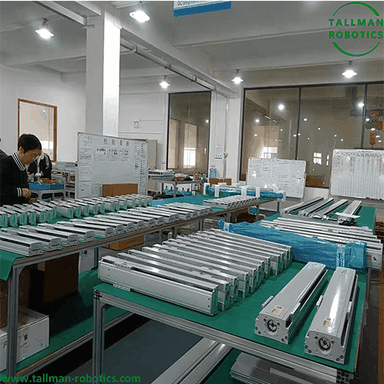
Here, we introduce our Belt Driven Actuator,with data as follows:
Timing Belt Linear Module for General Environment TM-B-CM
|
Model No |
Body Width (mm) |
Max Payload (kgs) |
Max Stroke (mm) |
Repeatability (mm) |
Drive |
Motor Power (W) |
Application Environment |
|
TM-B45-CM |
45 |
4 |
800 |
±0.04 |
belt |
50/100 |
General |
|
TM-B62-CM |
62 |
16 |
2000 |
±0.04 |
belt |
100/200/400 |
General |
|
TM-B65-CM |
65 |
4 |
800 |
±0.04 |
belt |
50/100 |
General |
|
TM-B85-CM |
85 |
16 |
2000 |
±0.04 |
belt |
100/200/400 |
General |
|
TM-B100-CM |
100 |
40 |
3500 |
±0.04 |
belt |
100/200/400 |
General |
|
TM-B135-CM |
135 |
42 |
3500 |
±0.04 |
belt |
200/400 |
General |
|
TM-B150-CM |
150 |
75 |
3500 |
±0.04 |
belt |
400/750 |
General |
|
TM-B170-CM |
170 |
75 |
3500 |
±0.04 |
belt |
400/750 |
General |
|
TM-B220-CM |
220 |
75 |
3500 |
±0.04 |
belt |
750 |
General |
Timing Belt Linear Module for Dust-proof Environment TM-B-CR
|
Model No |
Body Width (mm) |
Max Payload (kgs) |
Max Stroke (mm) |
Repeatability (mm) |
Drive |
Motor Power (W) |
Application Environment |
|
TM-B45-CR |
45 |
4 |
800 |
±0.04 |
belt |
50/100 |
Clean environment |
|
TM-B62-CR |
62 |
16 |
2000 |
±0.04 |
belt |
100/200/400 |
Clean environment |
|
TM-B65-CR |
65 |
4 |
800 |
±0.04 |
belt |
50/100 |
Clean environment |
|
TM-B85-CR |
85 |
16 |
2000 |
±0.04 |
belt |
100/200/400 |
Clean environment |
|
TM-B100-CR |
100 |
40 |
3500 |
±0.04 |
belt |
100/200/400 |
Clean environment |
|
TM-B135-CR |
135 |
42 |
3500 |
±0.04 |
belt |
200/400 |
Clean environment |
|
TM-B150-CR |
150 |
75 |
3500 |
±0.04 |
belt |
400/750 |
Clean environment |
|
TM-B170-CR |
170 |
75 |
3500 |
±0.04 |
belt |
400/750 |
Clean environment |
|
TM-B220-CR |
220 |
75 |
3500 |
±0.04 |
belt |
750 |
Clean environment |


FAQ
What advantages does a belt driven actuator offer over a screw-driven actuator?
Belt driven actuators generally support higher speeds and longer travel distances at a lower cost, while screw-driven actuators typically offer greater positioning precision and load-holding capability.
Is a belt driven actuator suitable for vertical lifting applications?
It can be used vertically, but since belts don't inherently self-lock, a motor brake is usually required to prevent the load from dropping when power is removed.
How does temperature affect belt driven actuator performance?
Temperature extremes can affect belt material properties, potentially causing stretching, stiffening, or accelerated wear, so belt material should be matched to the expected operating environment.
What's the typical service life of the belt in a belt driven actuator?
Service life varies widely based on load, speed, duty cycle, and environmental conditions, with belts generally requiring periodic inspection and eventual replacement as part of routine maintenance.
Can a belt driven actuator be retrofitted with a different belt type?
In many cases yes, provided the pulleys are compatible with the new belt's pitch and width, though this should be verified against the manufacturer's specifications to maintain rated performance.
Hot Tags: belt driven actuator, China belt driven actuator manufacturers, suppliers, factory, Belt Pulley Linear Traverse System, Linear Belt Drive, Timing toothed belt linear actuator, Pulley Belt Linear Propulsion Assembly, Totally Enclosed Belt Drive System, Linear Sliding Rail System


