


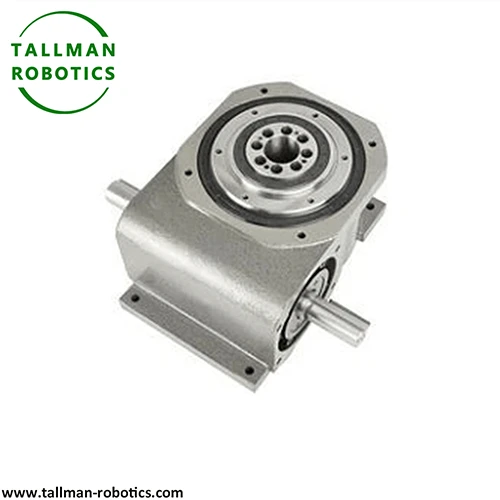

Positioning Cam Indexer is an intermittent transmission device designed with precise positioning function as its core objective. Through the precise mechanical meshing between the cam and the driven mechanism, it converts continuous rotational motion into a composite motion of "intermittent indexing+stable positioning" at the output end (such as workbench, turntable). Its core feature is the ability to stably lock the load in the preset position with minimal positioning error after completing workstation switching (indexing), making it a key component for achieving high-precision intermittent operations in automation equipment.
The operation of Positioning Cam Indexer revolves around the cycle of "indexing-positioning-reindexing", and its core function is reflected in two stages:
1). Division stage (transposition)
When the motor drives the active cam to rotate, the cam profile pushes the driven parts (rollers, pins, etc.) through mechanical force, driving the output shaft or worktable to quickly rotate at a preset angle (such as 30 °, 45 °, 60 °) to complete the workstation switching. The motion during this stage is controlled by a cam curve (such as a modified sine curve) to ensure smooth acceleration/deceleration and reduce load vibration.
2). Positioning stage (locking)
When the cam rotates to the "locking section" (a specially designed contour, usually a circular arc or plane), the driven part closely adheres to the cam contour without relative displacement, and the output end is completely stationary and forms mechanical self-locking. At this point, the load (such as workpieces, fixtures) is precisely fixed in the preset position, ensuring that external equipment (such as robotic arms, machining tools) can complete tasks (such as drilling, welding, and inspection) in a stable state.
The essential difference from ordinary cam indexers
|
Features |
Positioning Cam Indexer |
Ordinary Cam indexer |
|
Core design objective |
Prioritize ensuring positioning accuracy and locking stability |
Emphasize indexing efficiency and basic reliability |
|
Positioning error |
Usually ≤ ± 30 arc seconds, high-precision models can reach ± 5 arc seconds |
Generally ± 1~± 5 arc minutes (accuracy is more than 10 times lower) |
|
Locking method |
Mechanical rigid locking (no external force dependence) |
Multi dependent on motor braking or friction force |
|
Applicable scenarios |
Precision machining, testing, high-endassembly |
Ordinary packaging, conveying, sorting |
Why can high-precision positioning be achieved?
The high precision of Positioning Cam Indexer comes from the following design details:
|
Zero clearance meshing |
The cam and the follower (roller) are precision ground with a tolerance controlled at the micrometer level (usually ≤ 0.005mm) to eliminate transmission clearance and avoid positioning drift. |
|
Rigid locking structure |
The cam profile of the locking section is in surface contact with the driven component, and positioning is achieved through mechanical rigidity rather than external forces (such as motor brakes), with strong anti-interference ability (not affected by voltage fluctuations or load changes). |
|
Material and Heat Treatment |
The cam is made of high-strength alloy steel (such as 42CrMo), which has a hardness of HRC 58-62 after quenching treatment. It has excellent wear resistance and minimal degradation of contour accuracy after long-term use. |
|
Integrated support |
The machine base and shaft system are cast or forged as a whole to reduce assembly errors and ensure the relative positional accuracy of the cam and output shaft (parallelism/perpendicularity error ≤ 0.01mm/m). |
Here In this page, we introduce 90 DA Cam Indexers from TallMan Robotics, which is the top leading manufacturer of Cam Indexer, you will see data sheet, production pictures,vedios as follows:
Also You are welcome to watch more projects or visit our video gallery by Youtube: https://www.youtube.com/@tallmanrobotics


What is the core parameter of positioning accuracy?
|
Positioning error |
The deviation between the actual position and the theoretical position after a single division. High precision models can reach ± 5~± 10 arcseconds, while ordinary models typically have a deviation of ≤ ± 30 arcseconds. |
|
Repetitive positioning accuracy |
The consistency of positioning error after multiple divisions can be controlled within ± 2 arc seconds for excellent products, ensuring consistency in mass production. |
|
Locking force |
The maximum radial/axial load that can be sustained during the positioning stage (usually up to several tons), ensuring that no displacement occurs during stress processes such as machining and assembly. |
What are the typical application scenarios of Positioning Cam Indexer?
Positioning Cam Indexer is widely used in fields with strict requirements for position accuracy and stability due to its integrated advantages of "indexing+positioning"
|
Precision manufacturing |
For example, the positioning of the worktable of the mobile phone frame drilling machine ensures that the aperture and hole position tolerance are ≤± 0.01mm. |
|
Electronic assembly |
The wire bonding station of chip packaging equipment needs to control the wafer positioning error at the micrometer level. |
|
Optical Inspection |
Lens module inspection equipment, which drives the stage through a positioning divider to ensure the alignment accuracy between the inspection lens and the workpiece. |
|
Medical equipment |
Assembly line for minimally invasive surgical instruments, requiring component assembly position error ≤ 0.05mm to avoid affecting instrument function. |
Positioning Cam Indexer is an integrated solution of "high-precision intermittent transmission+rigid positioning", which achieves efficient workstation switching and stable job positioning in automated production lines through precise mechanical structure design. Its core value lies in eliminating the complex design of requiring additional positioning devices after division, and meeting the dual requirements of precision and efficiency in high-end manufacturing with a minimalist structure. It is a key foundational component in the field of precision automation.
The accuracy level classification of cam indexers is based on quantitative indicators of their core performance parameters (such as positioning error, repeat positioning accuracy, etc.), aiming to provide clear selection criteria for different application scenarios. But the core division logic is highly consistent - with "positioning accuracy" and "operational stability" as the core indicators, combined with the accuracy requirements of application scenarios for grading
The precision level of cam indexers is essentially a quantitative grading of "positioning error+repeated positioning accuracy", covering the full range of requirements from cutting-edge manufacturing to general automation, from ultra precision level (± 5 arcseconds) to ordinary level (± 3 arcminutes). When selecting, it is necessary to consider the position tolerance, operating frequency, and load characteristics of the specific equipment, rather than relying solely on the grade name - the core is to "accurately match" the accuracy parameters of the core with actual needs.
Hot Tags: positioning cam indexer, China positioning cam indexer manufacturers, suppliers, factory, Cam Indexing Unit, Cam Indexing Device for Assembly Lines, Heavy duty Cam Indexing Mechanism, Incremental Cam actuated Indexer, Indexing Cam Unit, Indexing Positioner with Cam Actuation


