


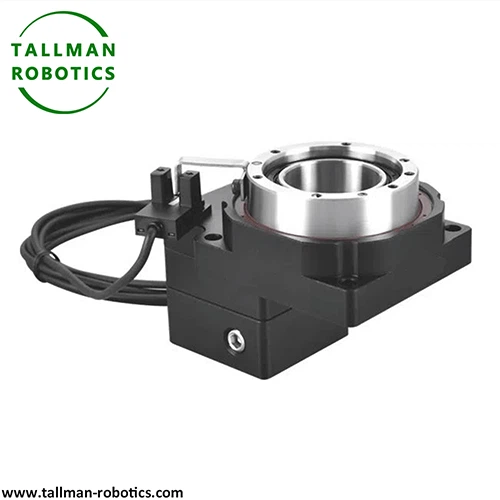
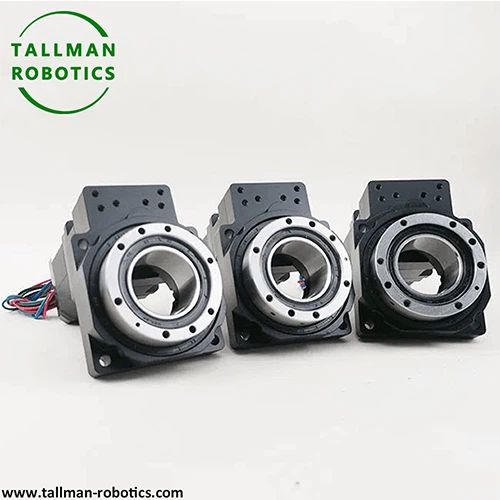


What is Hollow Rotary Semiconductor Table?
A hollow rotary semiconductor table is an ultra-precision rotary positioning platform featuring a central through-bore, engineered specifically for wafer handling, inspection, and processing equipment in cleanroom semiconductor manufacturing. The hollow center allows vacuum lines, electrical wiring, or optical sensor cables to pass through the rotation axis, enabling clean, low-particle integration without external cable routing that could introduce contamination or wear-related debris.
Structure
The table integrates a low-particulate, direct-drive or precision reduction stage (often torque motor or harmonic-driven) beneath a lightweight, low-outgassing worktable surface, supported by high-precision cross-roller bearings for minimal runout and vibration. The central bore runs concentrically through the drive and table, allowing vacuum chucking lines or wafer sensor cables to pass through without external routing. Encoders with sub-arcsecond resolution are typically integrated for closed-loop positioning feedback.
Selection Considerations
Key factors include bore diameter, positioning accuracy and repeatability (sub-micron/arcsecond level), cleanroom classification compatibility, particle generation rate, outgassing characteristics of materials and lubricants, torsional stiffness, permissible load, and settling time. Vibration damping and thermal stability are especially critical since thermal drift or micro-vibration can compromise wafer alignment accuracy.
Applications
Hollow rotary semiconductor tables are used in wafer prealigners, inspection and metrology systems, die bonding equipment, and lithography stage positioning where ultra-precise rotational alignment combined with clean pass-through routing is essential for process integrity.
Installation Considerations
Installation must occur in a controlled cleanroom environment to prevent contamination. Vacuum and electrical lines routed through the bore require secure strain relief to avoid particle generation from cable flexing. Mounting surfaces must be precisely leveled and torqued in a cross pattern, and encoder calibration, vibration levels, and particle-shedding should be verified post-installation before production use.
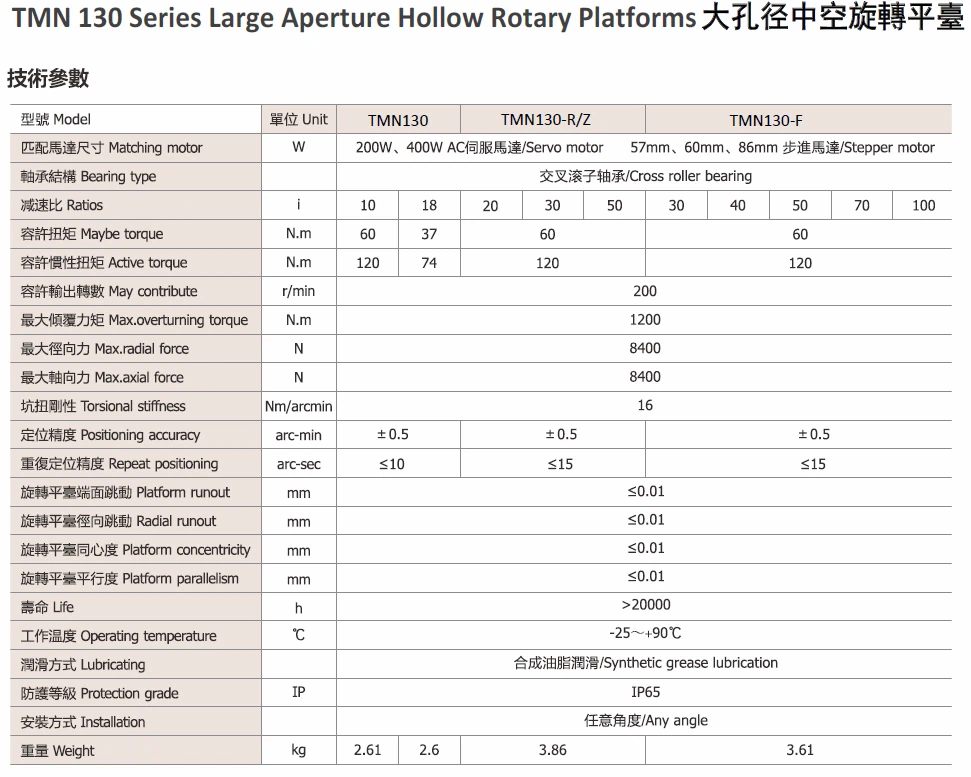
Here In this page, we introduce series of Hollow Rotary Semiconductor Table TMN130,
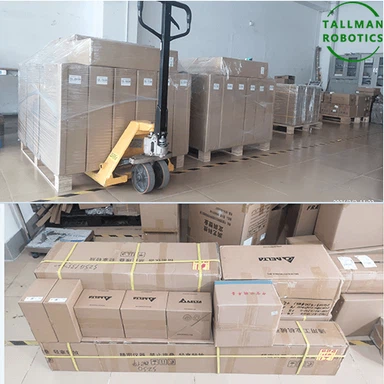
you will see data sheet, production pictures,videos of test as follows:
Also You are welcome to watch more projects or visit our video gallery by Youtube: https://www.youtube.com/@tallmanrobotics




FAQ:
1. What are the common sizes of the hollow aperture of the hollow rotary tables?
Common aperture specifications: The hollow aperture of mainstream hollow rotating platforms ranges from 10mm to 600mm, with specific models such as 28mm, 33mm, 62mm, 100mm, 150mm, and larger aperture models reaching over 600mm
2. What is the impact of the size of the hollow aperture on the performance of hollow rotary tables?
The impact of aperture on performance: The larger the aperture, the weaker the platform rigidity. An excessively large aperture can lead to insufficient wall thickness and uneven stress, thereby reducing load-bearing capacity and bending and torsional performance, affecting operational accuracy and stability. Strictly control the ratio of aperture to wall thickness during design.
3. What is the material of the inner wall of the hollow structure and is it wear-resistant?
Inner wall material and wear resistance: The inner wall material is consistent with the platform body, commonly using aluminum alloy, cast iron, alloy steel, etc. The inner wall generally does not directly bear high-frequency friction, but if it is necessary to thread cables or ventilation pipes, surface hardening, anodizing and other treatments can be used to improve wear resistance and corrosion resistance.
4. Does the hollow structure support threading, tubing, or ventilation functions?
Functional support: The hollow structure fully supports threading, piping, and ventilation. Cables, air pipes, optical fibers, coolant pipes, and laser beams can all pass through the hollow holes, effectively solving the problem of pipeline entanglement during rotational motion.
5. How to ensure the structural strength of large aperture hollow rotary tables?
Measures to ensure the strength of large aperture structures: ① Use high-strength alloy steel or cast iron materials, ② Use high-precision cross roller bearings to enhance rigidity, ③ Strictly control the ratio of aperture to wall thickness, ④ Optimize the layout of reinforcement bars for stress, ⑤ Standardize assembly processes and avoid overloading and deviation during transportation
Hot Tags: hollow rotary semiconductor table, China hollow rotary semiconductor table manufacturers, suppliers, factory, Through Hole Rotary Tables, Hypoid Gear Equipped Hollow Actuator, Large Aperture Rotary Tables, Pulsed Cam Indexing Device, Heavy Duty Hollow Rotary Work Platform, Electric Motor Driven Rotary Table


