
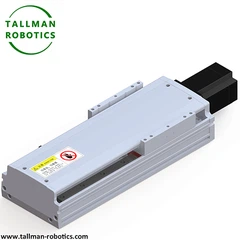


Hey there! As a supplier of three-axis gantries, I've been getting a bunch of questions lately about whether a three-axis gantry can be used for CNC machining. Well, I'm here to break it down for you and give you the lowdown.
First off, let's talk about what a three-axis gantry is. It's a type of robotic system that can move in three directions: X, Y, and Z. This gives it the ability to reach different points in a three-dimensional space. You can check out more about XY Cartesian Gantry System to get a better understanding of the basic concept of gantry systems.
Now, let's dive into CNC machining. CNC stands for Computer Numerical Control. In CNC machining, a machine tool is controlled by a computer program to perform precise cutting, drilling, and shaping operations on a workpiece. The key here is precision and repeatability.
So, can a three-axis gantry be used for CNC machining? The answer is a resounding yes! There are several reasons why a three-axis gantry can be a great fit for CNC machining.
Precision and Accuracy
One of the main requirements of CNC machining is precision. Three-axis gantries are designed to provide high levels of accuracy in their movements. They use high-quality linear guides and ball screws, which ensure smooth and precise motion in all three axes. This precision allows for the creation of intricate and detailed parts with tight tolerances. For instance, in the production of small mechanical components or electronic parts, the precision of a three-axis gantry can be crucial.
Flexibility
Three-axis gantries offer a great deal of flexibility. They can be easily programmed to perform a variety of machining operations. You can use them for milling, drilling, and even engraving. This flexibility makes them suitable for a wide range of industries, from automotive to aerospace. Whether you're making custom parts for a high - performance car or components for a satellite, a three-axis gantry can adapt to your needs. You might want to explore 3 Axis Cartesian Robot to see the kind of flexibility these systems can offer.
Workspace
Another advantage is the large workspace that a three-axis gantry provides. Compared to some other types of CNC machines, gantries can cover a relatively large area. This is especially useful when you need to machine large workpieces. You can position the workpiece on the table and let the gantry move freely over it to perform the necessary operations. This makes it an ideal choice for industries that deal with large - scale manufacturing, such as shipbuilding or large - part fabrication.
Cost - Effectiveness
In terms of cost, three-axis gantries can be a cost - effective solution for CNC machining. They are generally more affordable than some of the more complex multi - axis machining centers. This makes them a great option for small and medium - sized businesses that want to get into CNC machining without breaking the bank. You can also get high - quality Multi Axis Linear Actuator as part of the gantry system, which offers good performance at a reasonable cost.
However, like any technology, there are also some limitations to using a three-axis gantry for CNC machining.
Limited Complexity
Three-axis gantries are great for simple to moderately complex parts. But when it comes to extremely complex geometries that require multi - axis simultaneous movement, they might fall short. For example, parts with undercuts or complex free - form surfaces may be difficult to machine with a three - axis gantry alone. In such cases, you might need to consider a 3 Axis Gantry Robot or a more advanced multi - axis system.
Setup and Programming
Setting up and programming a three-axis gantry for CNC machining can be a bit challenging, especially for those who are new to the field. You need to have a good understanding of CNC programming languages and the kinematics of the gantry system. But with the right training and resources, it's definitely doable.
Maintenance
Like any mechanical system, a three-axis gantry requires regular maintenance. The linear guides, ball screws, and other moving parts need to be lubricated and inspected regularly to ensure smooth operation. Failure to perform proper maintenance can lead to reduced accuracy and increased wear and tear.
In summary, a three-axis gantry can be a great option for CNC machining, especially for applications that require precision, flexibility, and a large workspace. It's a cost - effective solution that can meet the needs of many industries. However, it's important to be aware of its limitations and to ensure proper setup, programming, and maintenance.
If you're in the market for a three-axis gantry for your CNC machining needs, I'd love to have a chat with you. We can discuss your specific requirements and see how our products can fit into your production process. Whether you're just starting out in CNC machining or looking to upgrade your existing equipment, we've got the expertise and the products to help you succeed. So, don't hesitate to reach out and start the conversation about how a three - axis gantry can take your CNC machining to the next level.


References
- General knowledge of CNC machining and three - axis gantry systems from industry experience.
- Information from product specifications and technical documentation related to gantry systems.


