
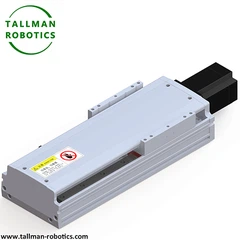


As a supplier of linear motors, I often encounter questions from customers about the heat generation of these motors. Heat generation is a critical aspect of linear motor performance, as it can impact efficiency, reliability, and the overall lifespan of the motor. In this blog, we'll explore what causes heat generation in linear motors, its effects, and ways to manage it effectively.
Understanding Linear Motors
Before delving into heat generation, let's briefly understand what linear motors are. A Linear Motor is an electric motor that produces a straight-line motion instead of a rotational motion like traditional motors. There are mainly two types of linear motors: Linear Induction Motor (LIM) and Linear Synchronous Motor (LSM).
In a LIM, a traveling magnetic field induces a current in the secondary part (usually a conductive plate), which then creates a magnetic field that interacts with the primary field to produce linear motion. An LSM, on the other hand, has a permanent magnet on the secondary part, and the interaction between the magnetic fields of the primary and secondary creates the linear motion. Linear motors are widely used in various applications, including Industrial Linear Motor System and Linear Electric Motor Actuator, such as in high-speed trains, machine tools, and automated manufacturing processes.
Causes of Heat Generation in Linear Motors
Copper Losses
One of the primary causes of heat generation in linear motors is copper losses, also known as I²R losses. In the motor's windings, when an electric current passes through the copper conductors, there is resistance. According to Joule's law, the power dissipated as heat in a conductor is given by P = I²R, where I is the current flowing through the conductor and R is its resistance. As the current increases or the resistance of the winding goes up, more heat is generated. This can happen due to factors such as an overly high load current, poor-quality copper in the windings, or a design with a high resistance value.
Iron Losses
Iron losses, also known as core losses, occur in the motor's magnetic core. These losses are divided into two main types: hysteresis losses and eddy current losses. Hysteresis losses result from the repeated magnetization and demagnetization of the core material as the magnetic field alternates. Each time the magnetic field changes direction, the magnetic domains in the core material must realign, which consumes energy and is dissipated as heat.


Eddy current losses, on the other hand, are caused by the induction of circulating currents, called eddy currents, in the conductive core material. When the magnetic field in the core changes, these eddy currents are induced, and they flow in loops within the core. The resistance of the core material causes these eddy currents to dissipate energy as heat. To reduce eddy current losses, the core is often made of laminated materials, which increase the resistance to the flow of eddy currents.
Friction and Windage Losses
Friction losses occur at the mechanical interfaces in the linear motor, such as between the moving parts and the bearings. As the motor operates, the relative motion between these parts creates friction, which converts mechanical energy into heat. Windage losses, on the other hand, are due to the resistance of the motor's moving parts to the air. When the motor moves at high speeds, the air resistance can cause significant heat generation.
Stray Load Losses
Stray load losses are additional losses that are difficult to quantify precisely. They can be caused by factors such as non-uniform current distribution in the windings, leakage fluxes, and the interaction between the motor and the load. These losses also contribute to the overall heat generation in the linear motor.
Effects of Heat Generation
Reduced Efficiency
Heat generation in linear motors leads to a reduction in efficiency. When energy is dissipated as heat, it means that less of the input electrical energy is being converted into useful mechanical work. This not only increases the operating costs but also requires a more powerful power supply to achieve the same level of performance.
Thermal Expansion
The heat generated can cause thermal expansion of the motor's components. This can lead to changes in the dimensions of the motor, which may affect its alignment and clearance. In extreme cases, thermal expansion can cause mechanical failures, such as seizure of the moving parts or damage to the windings.
Degradation of Insulation
The high temperatures generated in the motor can also degrade the electrical insulation of the windings. As the insulation deteriorates, the risk of short circuits and electrical failures increases. This can significantly reduce the lifespan of the motor and lead to costly downtime.
Impact on Control Systems
Excessive heat can also affect the performance of the motor's control systems. The electronic components in the control circuits are sensitive to temperature changes, and high temperatures can cause them to malfunction or have reduced accuracy.
Managing Heat Generation
Cooling Systems
One of the most common ways to manage heat generation in linear motors is through the use of cooling systems. There are several types of cooling methods, including air cooling, liquid cooling, and refrigerant cooling.
Air cooling is the simplest and most cost - effective method. It involves using fans or blowers to circulate air around the motor to remove the heat. However, air cooling has limited cooling capacity and is suitable for motors with relatively low power ratings.
Liquid cooling, such as water cooling, is more efficient than air cooling. In a liquid cooling system, a coolant (usually water or a water - glycol mixture) is circulated through channels in the motor to absorb the heat. The heated coolant is then directed to a heat exchanger, where it releases the heat to the surrounding environment.
Refrigerant cooling is the most effective but also the most complex and expensive cooling method. It uses a refrigerant, similar to those used in air conditioners, to remove heat from the motor. This method is suitable for high - power linear motors that generate a large amount of heat.
Motor Design
Proper motor design can also help reduce heat generation. For example, using high - quality copper with low resistance in the windings can minimize copper losses. Additionally, using laminated core materials with low hysteresis and eddy current losses can reduce iron losses. The design of the mechanical components should also minimize friction and windage losses.
Load Management
Managing the load on the linear motor can also reduce heat generation. Operating the motor within its rated load capacity helps prevent excessive current flow, which reduces copper losses. Avoiding sudden starts and stops and using smooth acceleration and deceleration profiles can also reduce the stress on the motor and minimize heat generation.
Conclusion
Heat generation is an important aspect to consider when using linear motors. Understanding the causes and effects of heat generation, as well as implementing effective heat management strategies, is crucial for ensuring the efficient and reliable operation of linear motors. At our company, we are dedicated to providing high - quality linear motors that are designed to minimize heat generation and offer optimal performance. If you are interested in learning more about our Linear Motor products or have any questions about heat management in linear motors, we encourage you to contact us for a procurement discussion. We look forward to working with you to meet your linear motor needs.
References
- Krause, P. C., Wasynczuk, O., & Sudhoff, S. D. (2013). Analysis of Electric Machinery and Drive Systems. Wiley.
- Fitzgerald, A. E., Kingsley Jr, C., & Umans, S. D. (2003). Electric Machinery. McGraw - Hill.


